Monday, May 15, 2023

Mendel Perkins Plant Cell paper wins Canadian Society of Plant Biologists' 2023 Ragai Ibriham Best Student Paper Award

Congratulations to Dr. Mendel Perkins, who was awarded the Canadian Society of Plant Biologists' 2023 Ragai Ibriham Best Student Paper Award for his doctoral work published in The Plant Cell. The judges noted:

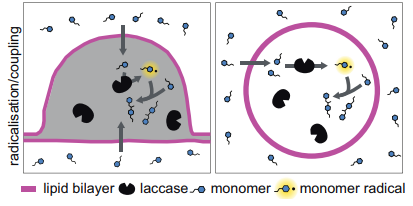
The article settles a long-standing and important question in plant biology, which is how monolignols are exported across the plasma membrane in order to be polymerized in the plant cell wall. Using a variety of advanced techniques, the authors show that lignin polymerization in the cell wall creates a concentration gradient that drives diffusion of monolignols across the lipid bilayer without protein transporters. The paper establishes a new paradigm in the field and has important implications not just for plant biology, but also for bioenergy and bioproduct applications.

Monolignol export by diffusion down a polymerization-induced concentration gradient

The Plant Cell, Volume 34, Issue 5, May 2022, Pages 2080–2095, https://doi.org/10.1093/plcell/koac051


This article was also the subject of a commentary:  

The Plant Cell, Volume 34, Issue 5, May 2022, Pages 1888–1889, https://doi.org/10.1093/plcell/koac050

Tuesday, March 21, 2023

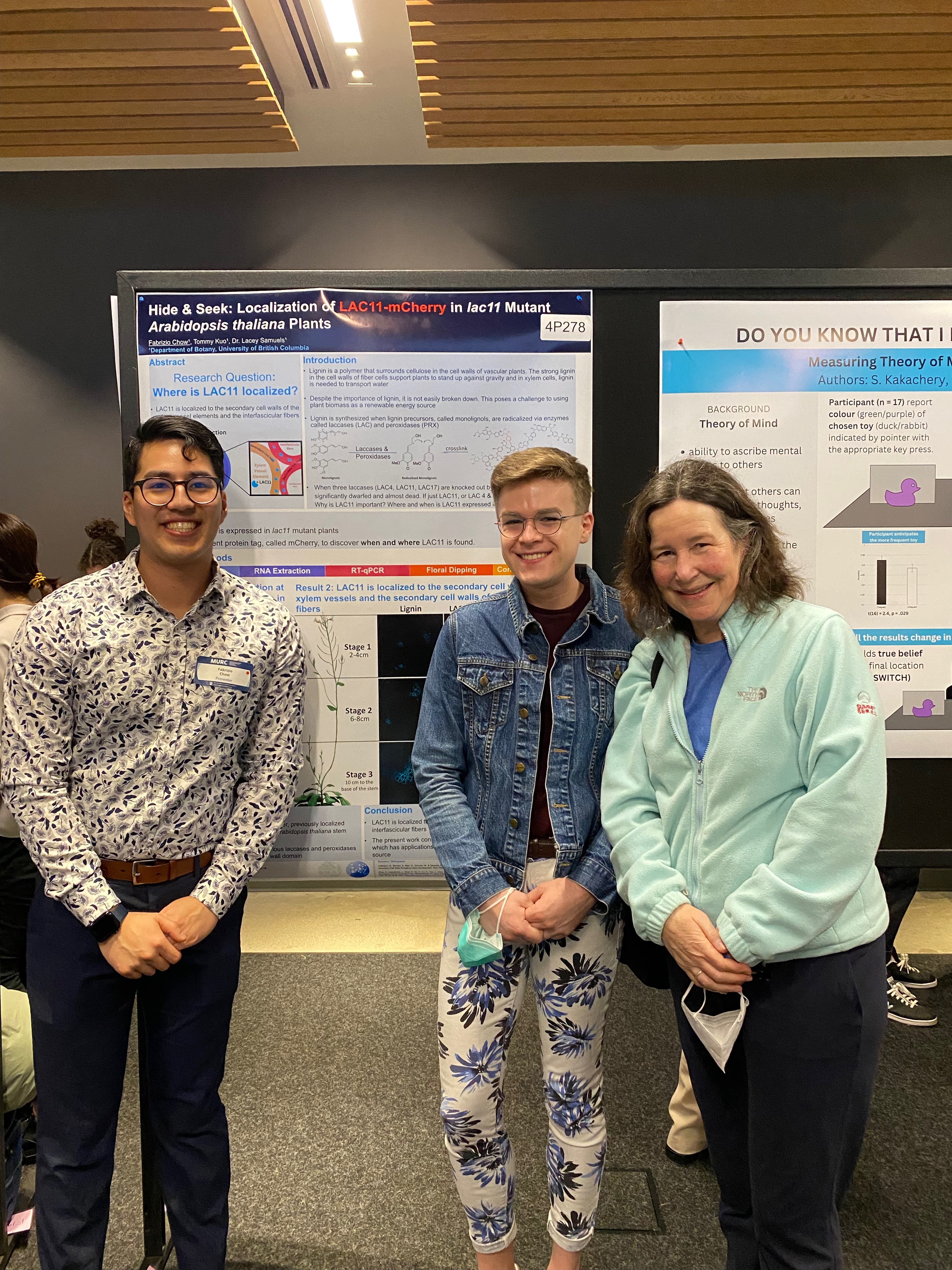
Congratulations to Fabrizio for a presentation well done at MURC!

 This weekend, our undergraduate student Fabrizio presented a poster of his directed studies work on the localization of LAC11 at the Multidisciplinary Undergraduate Research Conference (MURC). Drew and Lacey came along to hear his talk!


Monday, January 16, 2023

Congratulations to Drew Hall for receiving the Jonathan Page Fellowship in Botany to support their PhD studies on the diversity of cell wall biochemistry in the bryophytes!

Images: Drew in the lab looking at mosses!

Saturday, January 14, 2023

 Journal of Microscopy: Issue on Women in Microscopy

Lacey was asked to participate in a themed issue on pioneering women in microscopy. In consultation with Sam Livingston, we decided to share our technical adventures of preparing cannabis samples for transmission electron microscopy (TEM).

Our understanding of how cannabis plants produce their valuable metabolites is based on pioneering electron microscopy work by Paul Mahlberg and Eun-Soo Kim. They used classical chemical fixation to prepare their samples for transmission electron microscopy (TEM). In the Samuels lab, we also use high pressure freezing to prepare samples for TEM, and adapting these sticky cannabis flowers to this cryo-fixation protocol was not easy! Teagen Quilichini (post-doc) and Eva Chou (Directed Study) did extensive trouble shooting to find a way to preserve the cannabis, then Sam Livingston (PhD) expanded and built on their work. 

This resulted in amazing new views of how cannabis cells can produce compounds such as THC or CBD (see Sam's Current Biology paper). 

Sam's paper got picked up by these media and cannabis culture websites:

1.       Cannabist.net

2.       Cannabis Life Network

3.       Analytical Cannabis

4.       The Ubyssey

Thursday, September 29, 2022

Former PhD student Robin Young highlighted in UBC Today

Lab alum Dr. Robin Young investigates cell biology through an EDI lens in her position as Assistant Prof. of Teaching at UBC-Okanagan. [link]

Saturday, September 24, 2022

Check out Sam's papers on cannabis cell wall and metabolite trafficking!

The Samuels lab is happy to announce the publication of our new paper in Current Biology: A polarized supercell produces specialized metabolites in cannabis trichomes. We propose a new model of specialized metabolite trafficking in glandular trichomes based on ultrastructural and immunological investigations of cryofixed cannabis flowers. Using TEM, we demonstrate that the cells responsible for abundant cannabinoid and terpene biosynthesis are interconnected throughout trichome biogenesis, and become polarized during the transition to metabolite biosynthesis and secretion. Using novel polyclonal antibodies we reveal the nanoscale distribution of key enzymes for terpene biosynthesis in plastids (geranyldiphosphate synthase - GPPS), and cannabinoid biosynthesis (tetrahydrocannabinolic acid synthase - THCAS) in the apical cell wall of the glandular disc. These data reveal cannabinoid biosynthesis requires multiple highly distinct microenvironments for the production of valuable cannabinoids, and suggests the cannabinoid precursor cannabigerolic acid (CBGA) is the lipophilic metabolite trafficked from the plastid to the cell wall. Cryofixation revealed an abundance of membrane contact sites among plastids, endoplasmic reticulum, and plasma membrane, facilitating a model of lipophilic metabolite trafficking from plastid to plasma membrane via ER membrane contact sites.

---

For Sam's cannabis cell wallpaper in 2021, the Plant & Cell Physiology Journal made his paper the Editor's Choice for the issue and provided him with an Author Highlight. Recently, Sam received the Taylor A. Steeves Award for Best Student Paper in Plant Development, Structure or Morphology from the CBA/ABC, and a runner-up for the CSPB Ragai Ibrahim Best Student Paper.

Monday, March 7, 2022

New publication on monolignol trasport

The Samuels lab is happy to announce the publication of our new paper in The Plant Cell: Monolignol export by diffusion down a polymerization-induced concentration gradient. 

We present evidence for the hypothesis that monolignols can simply diffuse across cell membranes. This hypothesis has been around for many years but had yet to be rigorously tested. Using liposomes it was demonstrated that monolignols could diffuse through bilayer membranes. A multi-photon imaging system was used to quantify lignin and soluble phenolics in living plant roots which lent support to the role of diffusion in real living, lignifying cells. 


Our story was fortunate to be highlighted with an "In Brief" editorial in The Plant Cell and is featured on the UBC Botany website. This work was completed by Mendel PerkinsMathias Schuetz in the Samuels lab and collaborators from the MansfieldCastellarin and Bally labs. Read the paper here.

Friday, September 10, 2021

Jan's new paper on red algal cellulose synthases is out!

The Samuels lab is very happy to announce that Jan Xue and her co-authors have just published their work on red algal cellulose synthases in the Journal of Experimental Botany. This paper is the result of Jan's MSc thesis work completed in the Samuels and Martone labs at UBC. In addition Jan travelled to, and collaborated with, the Zimmer lab at the university of Virginia. Jan and her co-authors have combined phylogenetic analysis, heterologous expression, biochemical assays and fluorescent microscopy to further our understanding of cellulose synthases in Calliarthron tuberculosum. Read the paper here.


Tuesday, June 1, 2021

Dr. Livingston's Graduation!


A couple of stalked glandular trichomes with lovely compartments of terpenes and cannabinoids (for further details on that read the lovely paper here) stopped by the blog to congratulate Dr. Sam Livingston in advance of his PhD. graduation tomorrow. The Samuels lab is very happy for his success and though he will be missed we look forward to the great things he will surely accomplish next.


Monday, March 22, 2021

Congratulations to Sam for his PhD defense

The Samuels lab is very happy to announce that Sam Livingston defended his his PhD thesis successfully today. We congratulate him on his success and the advances he has made to the study of cannabis trichome development and structure. Sam used a wide variety of techniques including immuno fluorescence microscopy, high-pressure-freezing based cryofixation, immuno-TEM microscopy and multiphoton microscopy to study the cannabis trichomes. Sam has been able to describe the subcellular organization of organelles in the secretory cells with previously unattainable detail and quality of preservation. Sam has also made important discoveries in the makeup and development of the cell walls that ultimately hold the important metabolites such as THCA, CBDA and terpenes within the trichomes. Some of Sam's thesis work has already been published in The Plant Journal here.


Friday, February 26, 2021

Samuel King

Brief description of research:

Exploring the intracellular trafficking of cellulose synthases and xylan in post-Golgi compartments
during secondary cell wall construction in Arabidopsis.

Personal description:

I’m originally from Coquitlam, British Columbia, but I grew up on the shores of southern Nova Scotia. I lived in a very rural town, where much of my free time was spent wandering through ragged, hurricane-torn forests and rocky, wildflower-covered beaches. It was easy in that environment to begin wondering about the structural diversity of plants. I became really interested in what makes them so ubiquitous, specifically at the level of their cells, proteins, and genes. From this, I deeply wanted to know if there were bio-inspired technologies waiting to be created in light of plant cell biology.

Throughout my undergraduate degree, I’ve been lucky to have had various interdisciplinary experiences in research, ranging from synthetic biology to machine learning. In the Hallam Lab I investigated a high-throughput technique called Substrate Induced Gene Expression (SIGEX) to discover a neurotoxin-inducible gene present in marine metagenomic samples. With Dr. Steven Hallam, Dr. Eric Ma, and several undergrads, I also worked on developing a deep learning platform to model the trajectory of SARS-CoV-2 spike protein evolution in a continuous numerical space, where patterns of evolution might be more discernible than they are at the level of amino acid sequences. I’ve also been very fortunate to work in the UBC Bioimaging Facility as a research assistant, becoming familiar with the facility’s microscopy equipment. Toward the end of my degree, I found myself returning to the curiosities I had while growing up in Nova Scotia. That’s when I joined the Samuels Lab ready to complete my Honours thesis.

Plant secondary cell walls (SCWs) are responsible for much of the breathtaking structural diversity we see in the natural world, making up a major portion of the Earth’s organic biomass. Two integral components of the SCW are xylan and cellulose, which are fortifying polymers that weave throughout the wall to help it retain its architecture and protective properties. I am exploring the intracellular trafficking mechanisms of xylan and cellulose synthases (CESAs, the proteins that synthesize cellulose) during SCW construction. The two might be trafficked from the Golgi to the plasma membrane with a certain amount of cooperative coordination between their respective biosynthetic machinery. Therefore, co-localizing them in post-Golgi organelles would be insightful for cellulose and xylan biosynthesis, and for the coordination of cell wall construction as a whole. To co-localize CESAs and xylan, I am using immunogold TEM on Arabidopsis cells with upregulated SCW production due to the genetically engineered VND7i system.


Publications:

Hoffmann N., King S., Samuels A.L., McFarlane H.E. (2021). Subcellular coordination of plant cell wall synthesis. Developmental Cell. 56:933-948 [view abstract]

Wednesday, February 3, 2021

Congratulations Jan on her MSc defense!

By Rhododendrites - Own work, CC BY-SA 4.0

We are happy to announce that Jan Xue successfully defended her Master's thesis late last year. Jan studied the red algae Calliarthron. Jan's work delves into the evolutionary relationship between cellulose synthase enzymes in Calliarthron and land plants. In addition to the bioinformatic and computational work Jan also expressed and characterized algal cellulose synthase genes while visiting the Zimmer lab at the University of Virginia. 

We have the privilege of continuing to work with Jan in the lab since she will be continuing on in the Samuels lab as a PhD student. 

Kenzie Arnott


Coming to study at UBC has been the first I’ve lived in BC since I was born on Vancouver Island. Soon after I was born, my family and I moved all over both Canada and the United States, spanning both coasts before I made the big jump to the UK to pursue my BSc in Biochemistry. My early interests were in yeast and mammalian systems, but my head was quickly turned after doing my honours thesis under Dr. Giles Johnson at the University of Manchester. There, I investigated how photosynthetic capacity, FUM2 accumulation, and overall cold acclimation varies among Arabidopsis thaliana ecotypes.

My interest in plants was quickly sparked and in order to get even more hands on experience, I applied for and won a Plant Health Undergraduate Studentship under Dr. David Johnson. For the three months between my BSc and MSc, I spent my time digging around Trifolium repens and Trifolium pratense fields in Yorkshire Dales of North England. We wanted to determine whether clover experiencing herbivory were capable of affecting photosynthetic capacity in other clover plants that were connected via common mycorrhizal networks. We also investigated how these factors affected biomass, insect performance, nitrogen uptake, and CMN presence.

Afterwards, I wanted to learn more about how the innovative and still emerging field of Biotechnology could be applied to plant health and crop development. My MSc at the University of Edinburgh in Biotechnology allowed me both a varied and broad view of the diverse field as well as a more focused approach with one semester of applied research. My thesis focused on the effects of drought stress on transcriptional variation of an ABA pathway-related gene and root xylem/lignin morphology. This work with chickpea secondary cell walls led me to the Samuels lab at UBC for my second MSc in Botany.

I became apart of the Samuels lab January 2020 to try and satisfy my curiosity about the many questions surrounding secondary walls that came up during my previous thesis work. My current research focuses on how glycosyltransferases are recycled in the Golgi, specifically focusing on the xylan synthase complex. Currently, both the biosynthesis of xylan and the prevailing Golgi mechanistic model are incomplete. The current model for how the Golgi moves cargo from its cis to trans face is the cisternal maturation model. Here, each stack of the Golgi retains its cargo and moves from cis to trans like a conveyor belt before reaching the trans Golgi network where cargo can then be trafficked around the cell. However, recent data from Miranda Meents et al., 2019 (a previous PhD in the Samuels lab) shows that the enzymatic complex responsible for xylan synthesis – xylan synthase complex (XSC) – stays in the trans-medial cisternae of the Golgi stack. It is currently unknown how the XSC accomplished retrograde recycling. Therefore, the aim of this project is to answer the question: How do XSC proteins maintain their position within the cisternae of the Golgi and is this accomplished within or among Golgi stacks?

Jessica Hancock

Growing up on the west coast of British Columbia I often found myself in the spots between the forests and the ocean. With these areas teeming with diversity, it seemed only natural to become inquisitorial of plant life. Of particular interest to me was the complexity of forest systems. I became completely fascinated with the seemingly impenetrable strength of trees and not only their role within forest ecosystems but within both natural and anthropogenic global systems as well.

During my undergraduate degree I was extremely lucky to have ample opportunities to ask questions. However, I always found myself coming back to the same one; how can innovation be used to promote sustainable forest system management and conversation? While I examined this question from many different disciplinary standpoints, I found my passion in the realm of botany, specifically examining the diversity of secondary metabolites and their functions. 

Under the supervision of Dr. Marina Tourlakis and Dr. Emma Davy, I constructed my final thesis project which aimed to examine potential biomass substitutions to woody plants for use in pulp and paper products. Inspired by the work of Dr. Patrick Martone and Dr. John Ralph this research focused on the examination of lignin composition in the macro green algae species Cladophora glomerata.

Upon completion of my Bachelor's degree I found myself wanting to further examine concepts of cell biology so that I could continue asking and examining questions about the diversity of secondary metabolites. By beginning my MSc under the supervision of Dr. Lacey Samuels in January 2021 I intend to do just that. As a member of the Samuels lab, I will be investigating the production and secretion of metabolites in Cannabis sativa. Specifically, this research will examine how unique glandular trichome disc cell structure supports high levels of cannabinoid and terpenoid biosynthesis.

Tuesday, October 6, 2020

New publication


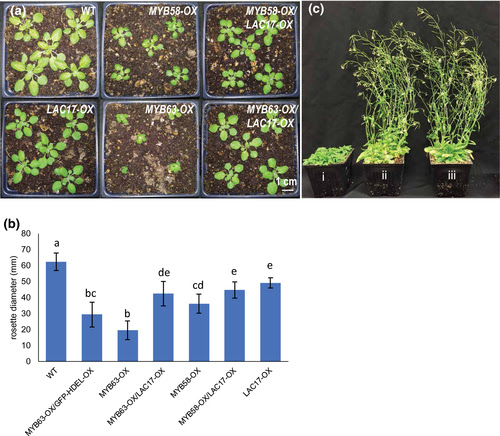
We are pleased to announce the publication of Dwarfism of high‐monolignol Arabidopsis plants is rescued by ectopic LACCASE overexpression in Plant Direct. Co-first authors Mendel Perkins and Mathias Schuetz and our many co-authors have used biochemistry, microscopy and transcriptomics to understand how laccases are able to alleviate the dwarfism caused by overexpression of MYB63 and MYB58 transcriptional regulators of the monolignol biosynthesis pathway. This work advances our understanding of the relationship between lignin monomer synthesis, lignin polymerization and impacts on growth which has been a pernicious problem that comes about when alterations are made with the goal of improving bioenergy production.


Laccases and peroxidases on the cover of Plant Physiology


Natalie Hoffmann and other Samuels lab alumni Anika Benske, Heather Betz and Mathias Schuetz have published a new paper in Plant Physiology. Their paper, Laccases and Peroxidases Co-Localize in Lignified Secondary Cell Walls throughout Stem Development, explores the developmental and spatial expression of a range of laccases and peroxidases using fluorescent proteins. This work expands our understanding of the roles that different oxidative enzymes play across different cell types, cell wall subdomains and developmental stages in the formation of lignin.


Not only did it make the cover, the paper was also highlighted and discussed in a News and Views editorial.

Wednesday, August 26, 2020

Congratulations Sam!

Sam has been officially awarded an honorable mention for the 2020 Ragai Ibrahim Award for Best Student Paper during the online Canadian Society of Plant Biologists annual business meeting. Sam's paper, a recent cover story in the Plant Journal, used a wide range of microscopy and omics techniques to advances our understanding of the development of the site of accumulation of many of the medical and recreational compounds in cannabis plants.


Wednesday, June 10, 2020

#ShutDownSTEM

Today instead of our regularly scheduled lab meeting we had a discussion of some of the history and context of racism in the USA, Canada and academic settings in particular.

Below are some of the resources that we shared and discussed with each other that we hope will help inform and stimulate discussion on racism.

This interactive resource to help understand the history of racism.

We read and listened to some of the materials on the #ShutDownSTEM.

We discussed the fact that history has hidden many tragic, racist events. Out of so many examples we highlighted two:


For those of you teaching UBC has a collection of resources to help discuss Indigenous issues in the classroom.

Finally and perhaps most importantly we have proposed some actions we can undertake moving forward.


  • Participating in a mentoring program for Indigenous high school students.
  • Presenting 'book reports' covering racial topics in our lab meetings. 


Thursday, May 21, 2020

2020 Ragai Ibrahim Award

We heartily congratulate Sam and his co-authors for being awarded honourable mention for the CSPB Ibrahim award for best student paper. Sam's paper, a recent cover story in the Plant Journal, used a wide range of microscopy and omics techniques to advances our understanding of the development of the site of accumulation of many of the medical and recreational compounds in cannabis plants.

Thursday, January 16, 2020

Sam's Cannabis paper published in Plant Journal

We heartily congratulate Sam and Teagen on the publication of their new paper. Using a wide range of microscopy and omics techniques this new paper advances our understanding of the development of the site of accumulation of many of the medical and recreational compounds in cannabis plants.


This paper was featured on the cover of The Plant Journal.